
Twin Lakes Advisory: Curly Leaf Pondweed: Now Confirmed in the Big Lake in Multiple Locations
Introduction
For years, Twin Lakes residents have wanted and hoped to preserve the natural beauty and health of our lakes. Unfortunately, we must now share important and concerning news: Curly Leaf Pondweed (CLPW), an aggressive aquatic invasive species, has been confirmed in multiple locations in the Big Lake as of July 1, 2025.
This spread did not happen overnight. Understanding how and why this occurred is essential so that we can act decisively to protect our lake ecosystem going forward.
Why Did This Happen?
The spread of CLPW to the Big Lake is likely the result of several interconnected factors:
Open Passageway: The water connection between the lakes remained open and unmanaged, allowing plant fragments to move downstream.
Mechanical & Manual Harvesting: Aggressive harvesting practices in the Little Lake created fragments as seen by lake residents, these drifted into the Big Lake, especially after barriers were removed.
Boat Traffic: Continued movement of boats and equipment along the shorelines likely transported fragments to new locations.
Missed Prevention Opportunities: Refusal to adopt comprehensive best practices and updated public awareness measures contributed to the unchecked spread.
While no single action fully explains the spread, a pattern of delayed and centralized decision-making, as well as missed opportunities to engage the entire community, played a significant role.
What Can You Do?
All Twin Lakes residents play a critical role in containing CLPW and protecting the lake:
✅ Avoid boating through or near shoreline vegetation. CLPW fragments can easily attach to boats, and paddles and fishing gear.
✅ Inspect and clean your boat, fishing gear, and any equipment after each use.Remove all visible plants and dispose of them away from the water.
✅ Spread the word. Encourage your Twin Lakes neighbors and visitors to follow these steps and remain vigilant.
✅ Support science-based, unified lake management efforts. Advocate for collaborative and transparent approaches to lake stewardship.
Conclusion
Now more than ever, it is essential for all of us to act as stewards of our lakes. By taking simple, proactive steps, we can help slow the spread of CLPW and preserve the health of our shared waters.
Moving forward, strong cooperation across all homeowner groups and individuals will be the key to a healthier, more resilient lake ecosystem.
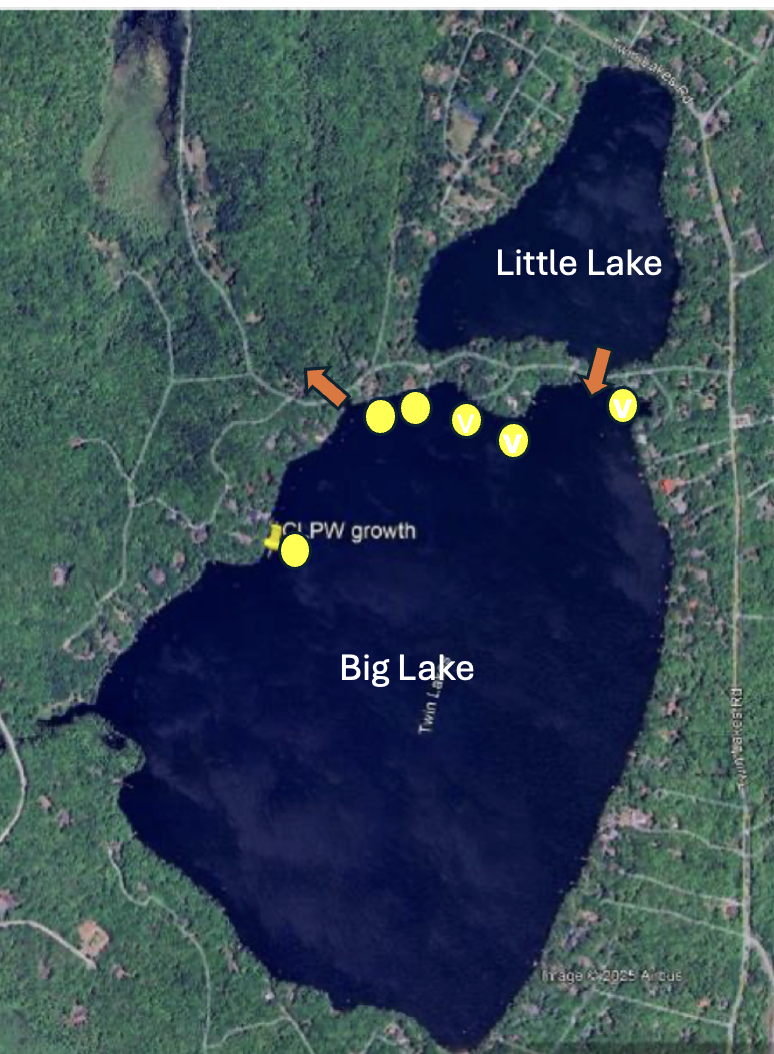
CLPW Spread Pathway: From Little Lake to Big Lake
Passageway between lakes have an open flow
Arrows indicating water flow into and out of the lakes : plant fragments moving from Little Lake to Big Lake and Big Lake with water inflows
New CLPW growth points marked in Big Lake in Yellow (e.g., near docks and shorelines).
Timeline: How We Got Here
2019–2020: CLPW first confirmed in Little Lake. No formal coordinated action was taken to contain or control it at that time.
2019–2024: Continued absence of any unified prevention plan despite growing concerns.
June 2023: A grassroots group formed to address water quality and encourage proactive strategies.
July 2023: Local lake leadership asked the grassroots group to step back, indicating it would take responsibility for lake management.
March 2024: The lake leadership group held a webinar and downplayed risks and emphasizes centralized decision-making, and discouraged outside collaboration.
April 2024: A contracted lake management company did an aquatic plant survey and reported there was no CLPW in the Big Lake; containment measures to restrict CLPW in the Small Lake were not implemented.
June 2024: Mechanical and manual harvesting was done in Little Lake; Big Lake publicly stated as “clear.”
August 2024: First acknowledgment of CLPW presence near the passageway into Big Lake.
August 2024: A Twin Lakes aquatic invasive species (AIS) webinar was held on CLPW prevention; no local lake leadership participated.
December 2024: Expert-provided invasive species signage is declined by some lake leadership; instead older, less effective signs remain in use.
June 2025: Some lake leadership communications sent out to claim no CLPW in Big Lake.
June / July 2025: CLPW confirmed in multiple Big Lake locations — including shorelines, docks, and private waterfronts primarily between the Little lake to Big Lake passageway and Big Lake Dam/Spillway.